What is frozen shoulder?
Frozen shoulder, or adhesive capsulitis, happens when the capsule of connective tissue around the shoulder joint becomes inflamed, thickens and tightens. Pain comes with a steadily shrinking range of motion. In Korea it is called osipgyeon, literally "fifties shoulder," because it is so common in midlife.
It mostly affects people aged 40 to 60, and women more than men. Diabetes raises the risk sharply: one analysis found more than one in ten people with diabetes have it. It is also more common with thyroid disease, or after the shoulder has been kept still for a long time because of surgery or a fracture.
Typical symptoms
- Pain that starts gradually: It begins without a clear injury and slowly gets worse.
- Worse at night: Lying on the affected side often wakes you up.
- Less movement in every direction: Raising the arm forward or sideways, rotating it outward, and reaching behind your back all get harder.
- The arm won't go up even when someone lifts it: The joint itself is stiff, not just weak, so another person cannot lift your arm past a certain point either.
How is it different from a rotator cuff tear?
A rotator cuff tear (a tear in the tendons that move the shoulder) is another common cause of shoulder pain after 50. The two are treated differently, so telling them apart matters. These are general patterns only; a proper diagnosis needs an examination and often ultrasound or MRI.
| Frozen shoulder | Rotator cuff tear | |
|---|---|---|
| When someone lifts your arm | Still won't go up (joint is stiff) | Usually goes up (the problem is weakness) |
| Limited movement | All directions, especially outward rotation | Pain or weakness at certain angles |
| Strength | Mostly preserved | Weak when holding the arm up |
| Onset | Gradual, no clear cause | Gradual wear, or sudden after a fall or heavy lift |
Other causes include calcific tendinitis, where calcium deposits in a shoulder tendon cause sudden, severe pain, and neck problems, which often send numbness from the shoulder down the arm into the hand.
Frozen shoulder self-check
If several of these apply to you, frozen shoulder is possible and it is worth seeing an orthopedic doctor. This list does not replace a diagnosis.
- It is hard to reach into a back pocket or fasten a bra behind your back.
- Your arm won't go all the way up when combing or washing your hair.
- Pain wakes you when you lie on that side.
- Your arm won't go up even when you lift it with your other hand.
- Your range of motion has shrunk over weeks to months.
You can also check shoulder and other symptoms with our pain self-check.
Does frozen shoulder go away on its own?
Frozen shoulder usually passes through three stages and often improves slowly over 1 to 3 years. But symptoms can linger: in a study that followed patients for an average of seven years (Shaffer et al., 1992), about half still had mild pain or stiffness. So rather than waiting it out, it is important to manage the pain and keep the shoulder moving.
| Freezing | Pain gets worse and movement decreases (about 6 weeks to 9 months) |
|---|---|
| Frozen | Pain may ease, but the shoulder is at its stiffest (about 4 to 6 months) |
| Thawing | Movement slowly returns (about 6 months to 2 years) |
Treatment usually involves anti-inflammatory pain relievers, steroid injections, physical therapy and stretching. If those are not enough, doctors may consider hydrodilatation (injecting fluid to stretch the capsule) or arthroscopic surgery.
Home stretches for frozen shoulder
The American Academy of Orthopaedic Surgeons recommends regular stretching as the core treatment. Warming the shoulder first with a warm shower or heat pack helps. Stretch only to the point of a gentle pull, and stop if you feel sharp pain.
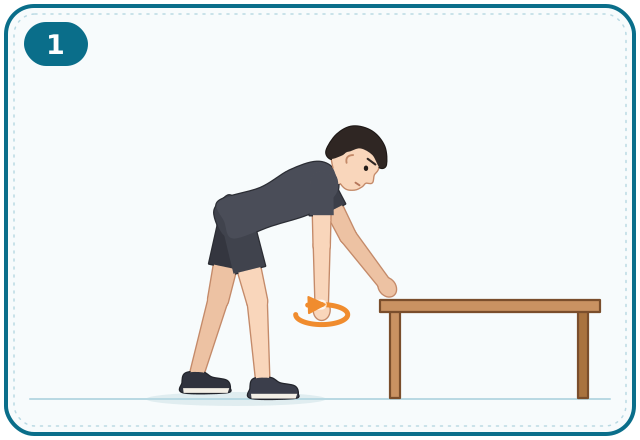
1. Pendulum stretch
Lean on a table with your good hand, bend forward and let the affected arm hang loose. Sway your body gently so the arm swings in small circles. Do 10 circles in each direction.
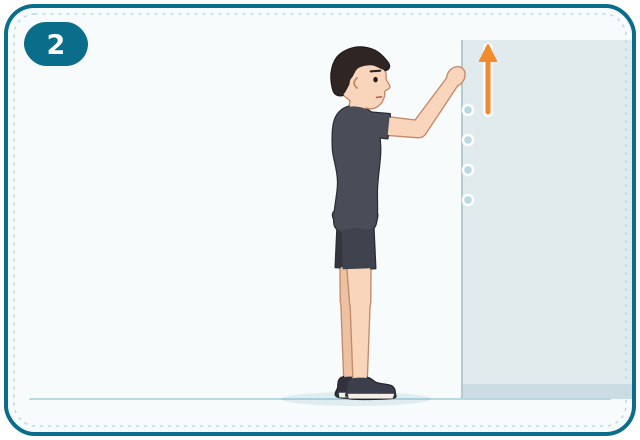
2. Finger walk
Face a wall about an arm's length away. Walk the fingers of the affected hand up the wall like a spider as high as is comfortable, then slowly lower. Repeat 10–20 times.
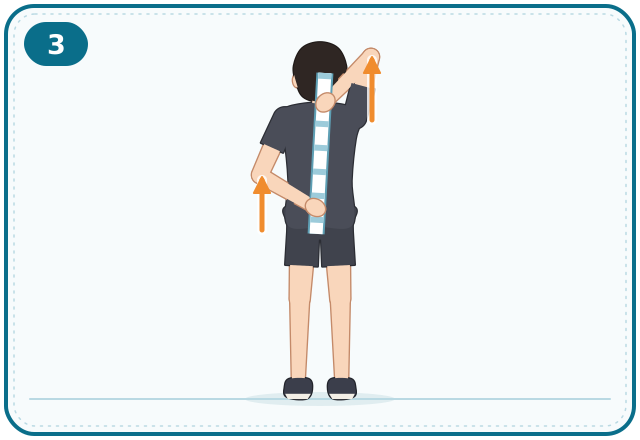
3. Towel stretch
Hold a towel behind your back with one hand above and one below. Use the good arm to pull the towel slowly upward, drawing the affected arm up your back. Repeat 10–20 times.
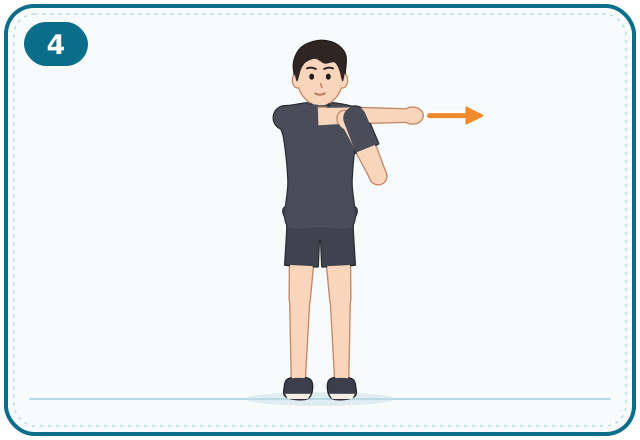
4. Cross-body reach
With your good hand, hold the affected arm just above the elbow and gently pull it across your chest. Hold for 15–20 seconds. Repeat 10–20 times.
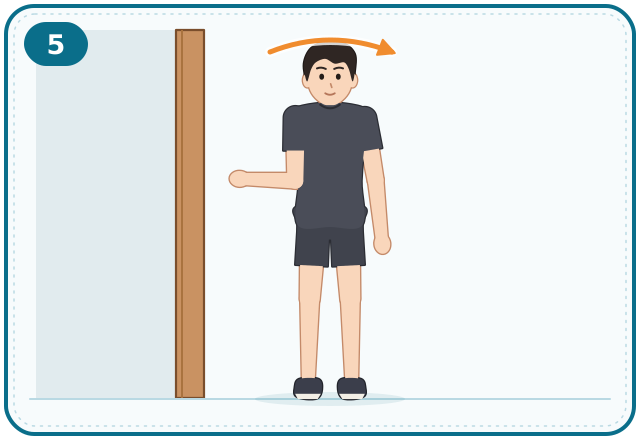
5. Outward rotation
Stand in a doorway with the affected elbow bent at 90 degrees and tucked against your side, palm on the door frame. Keeping the elbow at your side, slowly turn your body away so the shoulder rotates outward. This is usually the first direction to stiffen, so it matters most.
See a doctor right away if
- Your shoulder hurts and you cannot lift your arm after a fall or blow
- Your arm suddenly becomes weak, or your arm or hand goes numb
- The shoulder is swollen and warm, or you have a fever
- Left shoulder or arm pain comes with chest tightness, shortness of breath or cold sweats (this may be a heart problem; go to the emergency room)
Please keep in mind
- This article is based on information checked as of the date shown at the top. New research or changes in official guidelines may change the details, so please use it as a reference rather than taking it as definitive.
- For an accurate diagnosis and advice about your health, please see a doctor in person.