Why leg strength matters more with age
Muscle mass and strength naturally decline with age. When the thigh and buttock muscles in particular weaken, everyday movements such as getting up from a chair, climbing stairs, or standing up from the toilet gradually become harder, and the risk of falling rises too. The WHO's 2020 physical activity guidelines recommend that adults 65 and older do strength exercises for the major muscle groups on 2 or more days a week.
Chair squats are a lower-body strength exercise you can do at home with nothing but a sturdy chair. Because the chair supports you, they are safer than regular squats, and they let you practice the real-life movement of sitting down and getting up.
The benefits of chair squats
- Stronger thighs and buttocks: Trains the largest muscles you use to walk, stand, and climb stairs.
- Easier everyday movement: Getting up from chairs, sofas, and toilets becomes easier.
- Better balance and fewer falls: Stronger legs help you hold steady when you sway.
- Support for the knees: Stronger front thigh muscles help support the knee joint.
The evidence is fairly solid. A Cochrane systematic review (2009) of 121 trials with about 6,700 older adults found that progressive strength training, where the load is gradually increased, produced large gains in strength and small but meaningful improvements in physical function such as rising from a chair and walking. Most studies involved training 2–3 times a week for 8–12 weeks or longer, so a few sessions are not enough to judge the effect.
| Repetitions | 10–15 per set, 1–3 sets (1–2 minutes' rest between sets) |
|---|---|
| How often | 2–3 days a week, not on consecutive days |
| What you need | A sturdy chair without arms or wheels (placed against a wall) |
| Intensity | The last 2–3 repetitions should feel "somewhat hard" |
How to do a chair squat
- Set up the chair: Put a sturdy chair without wheels against a wall so it can't slide. Sit on the front half of the seat.
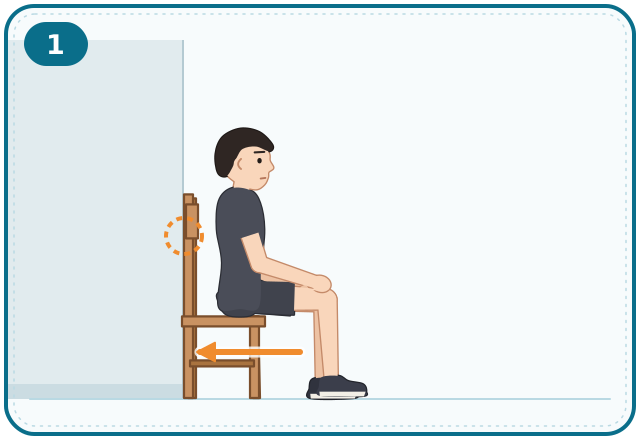
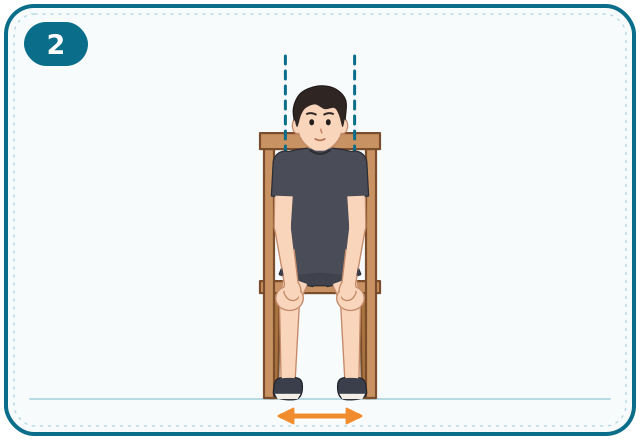
- Feet: Place your feet shoulder-width apart, toes pointing forward or slightly out, with your feet slightly behind your knees.
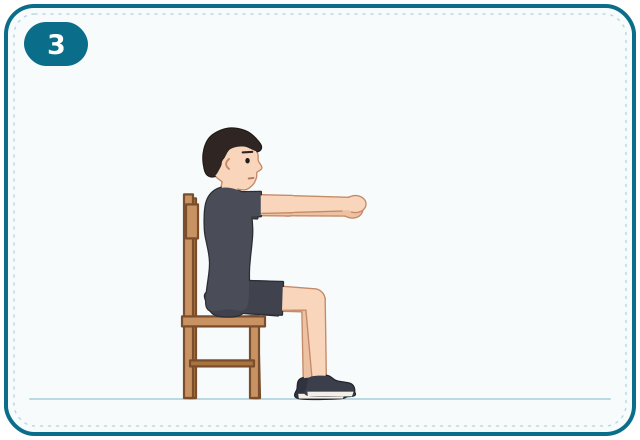
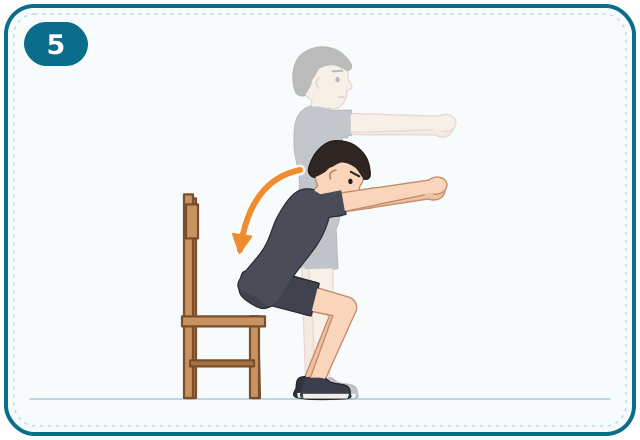
- Arms: Cross your arms over your chest or hold them straight out in front. At first, it's fine to push off the sides of the chair with your hands.
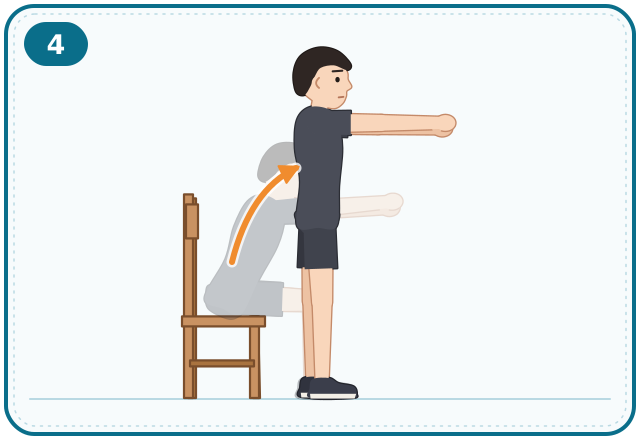
- Stand up: Lean your upper body slightly forward, breathe out, and push through your heels to stand up slowly. Squeeze your buttocks at the top.
- Sit down: Breathe in and lower yourself slowly over 3–4 seconds, pushing your hips back. Don't drop into the seat; as soon as your bottom lightly touches the chair, stand up again.
Making it harder, step by step
- To start: Push off the chair or your knees with your hands. Adding a cushion to raise the seat makes it easier.
- Once it feels easy: Do it without your hands, arms crossed over your chest.
- Once that feels easy: Lower yourself even more slowly, or pause for 1–2 seconds just before your bottom touches the chair, then stand.
The 30-second chair stand self-test
The US Centers for Disease Control and Prevention's (CDC) fall-prevention program, STEADI, uses the "30-second chair stand test" as a simple way to check leg strength and endurance. Sit in a chair without arms, cross your arms over your chest, and count how many times you can fully stand up and sit down in 30 seconds. If you are more than halfway up when time runs out, count it as one; if you need your arms to stand, the score is 0. A score below the numbers here suggests a risk of falling.
| Age | Men | Women |
|---|---|---|
| 60–64 | < 14 | < 12 |
| 65–69 | < 12 | < 11 |
| 70–74 | < 12 | < 10 |
| 75–79 | < 11 | < 10 |
| 80–84 | < 10 | < 9 |
| 85–89 | < 8 | < 8 |
Always do the test with a family member watching. If your score is below the benchmark, treat it as a reason to start exercising rather than something to worry about. Test again after a few weeks of regular exercise and you can see the change.
Precautions for chair squats
Please keep these in mind
- Check the chair: Don't use chairs with wheels, folding chairs, or light plastic chairs, which can slide or collapse.
- Knee direction: As you stand and sit, keep your knees pointing the same way as your toes, not caving inward.
- Don't hold your breath: Holding your breath while straining can spike your blood pressure. Breathe out as you stand and in as you sit.
- Pain rule: Muscle soreness is fine, but stop immediately if you feel a sharp, stabbing pain in your knee or back.
- Dizziness: Standing up quickly can make you dizzy (orthostatic hypotension), so move slowly and sit down to rest if you feel lightheaded.
- Past surgery: If you have had a knee or hip replacement, deep sitting may be restricted, so check with your surgeon or physical therapist first.
Please keep in mind
- This article is based on information checked as of the date shown at the top. New research or changes in official guidelines may change the details, so please use it as a reference rather than taking it as definitive.
- For an accurate diagnosis and advice about your health, please see a doctor in person.